
Credit Utilization Under 10%: What Nobody Explains
Payment history gets all the credit, but utilization is the lever that moves your FICO score fastest. Here's the math—and the playbook.
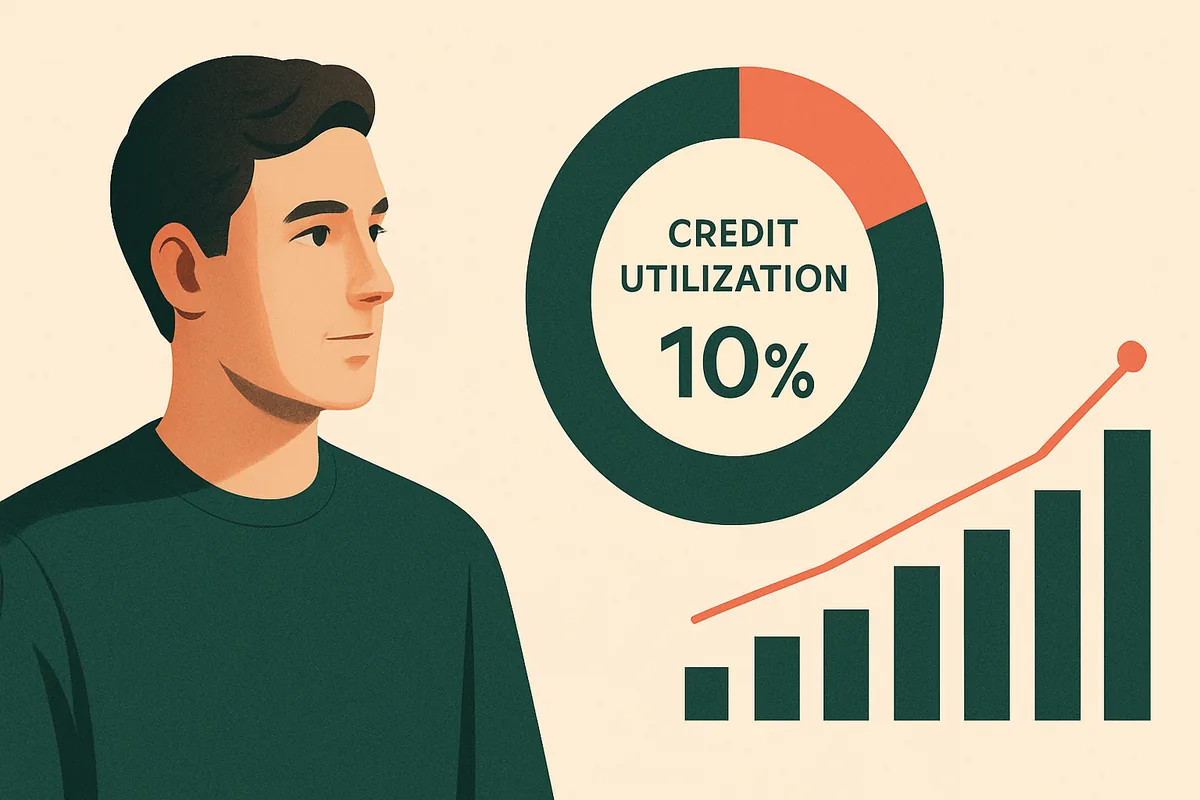
Most personal finance advice treats credit utilization like a footnote — keep it under 30%, the articles say, and move on. That number is not wrong, but it is deeply incomplete. The difference between 28% utilization and 8% utilization can be the difference between a 680 and a 740 FICO score, which in 2026 translates to roughly 1.2 percentage points on a 30-year mortgage rate, or about $74,000 in additional interest on a $400,000 loan. That is not a footnote. That is a financial strategy worth engineering.
This post explains exactly why utilization moves faster than payment history, when the 30% rule becomes a ceiling instead of a target, and four concrete tactics to drive your reported utilization below 10% — even if you carry a balance some months.
Why Utilization Hits Different Than Payment History
FICO 8, still the most widely used scoring model by lenders as of Q1 2027 according to FICO's own lender-usage disclosures, breaks your score into five weighted categories:
- Payment history — 35%
- Amounts owed (utilization) — 30%
- Length of credit history — 15%
- Credit mix — 10%
- New credit — 10%
On paper, payment history wins by five points. But here's what those percentages obscure: payment history is almost entirely binary. You either paid on time or you didn't. Once you've built 24 months of clean payment history, additional on-time payments produce diminishing returns. Utilization, by contrast, is a continuous variable you can manipulate in real time. Miss a payment and it stays on your credit report for seven years. Drop your utilization from 25% to 7%? The new, lower number appears on your report the very next month after your card issuer reports to the bureaus.
That asymmetry — slow decay for negative history, near-instant reward for utilization improvement — is why utilization is the fastest legitimate lever available to most consumers.
The 30% rule is a floor, not a target. Industry research consistently shows score optimization begins at under 10% utilization, not at 29%. Treating 30% as "good enough" is like treating a blood pressure of 139/89 as healthy because it's technically below hypertension.
The Snapshot Problem: How Bureaus Actually Record Your Balance
Here's the mechanic most articles skip entirely: credit bureaus do not record your balance at the end of each month after you pay. They record whatever balance your card issuer reports, and most issuers report on or near your statement closing date — not your due date, and not the date you pay.
This means you can pay your bill in full every single month and still show 40% utilization on your credit report, because the bureau captured your balance before your payment posted. Your credit score reflects a snapshot of your reported balance on the day your issuer transmitted the data.
How to Find Your Reporting Date
Call the number on the back of each card and ask: "What date do you report my balance to the credit bureaus?" Alternatively, pull your free report from AnnualCreditReport.com and note the "date of last activity" field on each revolving account — that is typically within a few days of the reporting date. Once you know the date, you can time a payment to land before it, ensuring a lower balance gets transmitted.
Four Tactics to Keep Utilization Below 10%
None of these require you to stop using credit cards. They require you to use them differently.
1. The Pre-Statement Payment
Instead of paying your statement balance after the due date, make a payment 3–5 days before your statement closes. Pay your balance down to under 10% of your limit, let the statement generate with that low balance, then pay the remainder before the due date to avoid interest.
Example: You have a $6,000 credit limit. Your typical spend is $2,200 per month (37% utilization if left unreported). Five days before closing, pay $1,700, leaving $500 on the account — 8.3% utilization. That $500 gets reported. You pay the $500 by the due date. You paid in full, avoided interest, and reported 8.3% utilization.
This single tactic, applied consistently across all your cards, accounts for the majority of utilization improvement our users at AtlasForge Financial observe within 60 days.
2. Request Credit Limit Increases Strategically
Utilization is a ratio. You can improve it by lowering the numerator (your balance) or raising the denominator (your limit). A limit increase costs nothing and, if your issuer uses a soft pull for the review, doesn't create a hard inquiry on your credit report.
The optimal timing for a limit increase request:
- At least 12 months after account opening
- After a meaningful income increase you can document
- After 6+ consecutive months of on-time payments
- Not within 90 days of a recent hard inquiry from another application
American Express, Chase, and Citi all offer self-service limit increase portals that frequently use soft pulls. Discover typically requires a hard inquiry — confirm before you apply. A jump from a $5,000 limit to $9,000 on a single card, with the same $600 balance, moves your per-card utilization from 12% to 6.7%.
3. Distribute Spending Across Cards to Manage Per-Card Utilization
FICO calculates utilization two ways: aggregate (all balances ÷ all limits) and per-card. You can have a 7% aggregate utilization and still take a scoring hit if one card is at 62% while others sit empty. The model penalizes high utilization on any individual revolving account.
The fix is card segmentation. Designate one card for recurring subscriptions and automated bills (keeps a predictable, low balance). Use a second card for variable discretionary spending, and monitor its balance actively. If you're approaching 10% on the discretionary card mid-cycle, shift remaining purchases to a card with more available credit. This requires about 10 minutes of monthly attention — it is not complicated, but it is deliberate.
For users of Safe to Spend 365, our daily spending intelligence automatically flags when a linked card's running balance is trending toward a utilization threshold, so the reallocation decision surfaces before your reporting date, not after.
4. Open a New Card — But Only as a Last Resort
Adding a card increases your total credit limit across the board, which mechanically lowers aggregate utilization. A new $8,000 limit card added to a credit profile with $20,000 in existing limits and $3,000 in balances moves aggregate utilization from 15% to 10.7% on day one, before you ever use the card.
The cost: a hard inquiry (typically a 5–10 point temporary dip) and a reduction in your average account age. This tactic is worth considering if:
- Your credit score is already above 700, meaning the inquiry impact is relatively modest
- You have fewer than 3 revolving accounts (credit mix matters)
- You will not be applying for a mortgage or auto loan within 12 months
- You have demonstrated you won't increase spending proportionally with the new available credit
If those conditions don't apply, exhaust the first three tactics before opening anything new.
The Two Utilization Numbers That Confuse Everyone
A brief clarification worth making explicitly: revolving utilization and installment utilization are not the same thing.
Credit cards, personal lines of credit, and HELOCs are revolving accounts — their utilization is the high-impact figure we've been discussing. Mortgages, auto loans, and student loans are installment accounts. The balance remaining on an installment loan relative to its original amount does factor into "amounts owed" but carries significantly less scoring weight than revolving utilization.
This is why aggressively paying down a car loan from 60% remaining to 40% remaining produces a much smaller score improvement than moving a credit card from 40% utilization to 8%. Prioritize revolving accounts when the goal is score optimization.
The Consumer Financial Protection Bureau's 2025 consumer credit report documented that over 43 million Americans have at least one revolving account with utilization above 30% — most of them without realizing their reported balance was the controllable variable.
What "Under 10%" Actually Means in Score Points
FICO does not publish its precise scoring algorithm — it's proprietary. But credit reporting agencies and third-party researchers have triangulated score behavior across millions of anonymized accounts. The consensus picture looks roughly like this:
- Above 50% utilization: Maximum negative impact to amounts-owed category
- 30–49%: Moderate penalty; still meaningfully suppressing scores
- 10–29%: Improvement zone; scores begin recovering noticeably
- 1–9%: Optimal zone; the model treats this as responsible, active credit use
- 0% (all cards at zero): Slightly suboptimal — lenders and models prefer to see some utilization, confirming you're an active borrower
The last point surprises people. Reporting exactly $0 on every card every month can slightly underperform reporting 2–5% utilization. Leave a small, intentional balance on one card — or make a small purchase in the week before your reporting date — to stay in the active-user range.
For a concrete sense of scale: moving from 35% aggregate utilization to 8% aggregate utilization, holding all other factors constant, produces score improvements in the 40–80 point range on FICO 8 for consumers in the 620–720 band, based on modeling published in the Federal Reserve's Report on the Economic Well-Being of U.S. Households (2024). For someone at 740 already, the same move might yield 15–25 points. The lower your starting score, the more dramatically utilization improvements register.
Monitoring the Right Metrics, Not Just the Score
The biggest mistake consumers make is treating their credit score as the primary dashboard and their credit report as a secondary detail. Invert that. Your score is an output — your credit report is the system you manage.
Monitor these four figures monthly across every revolving account on your credit report:
- Reported balance (what the bureau received from your issuer)
- Credit limit as reported (errors here are common and underreported)
- Per-card utilization (balance ÷ limit, card by card)
- Aggregate utilization (sum of all balances ÷ sum of all limits)
Errors in reported credit limits are more common than most borrowers realize. If an issuer reports your limit as $3,500 when it's actually $5,000, your reported utilization is artificially inflated through no behavior of your own. Dispute these through the bureau's online portal — Experian, Equifax, and TransUnion are all legally required under the Fair Credit Reporting Act to investigate within 30 days.
Our Ember360 dashboard pulls your linked account data and surfaces your per-card and aggregate utilization in a single view, updated each time a new report cycle closes. The goal is never to replace your direct relationship with your credit report — it's to make the key variables visible before they cost you points.
Making This Automatic, Not a Monthly Chore
The tactics above work. The challenge is sustaining them across 12, 24, 36 months — through life events, travel, irregular income months, and the simple fatigue of paying attention to something that doesn't reward you with an immediate dopamine hit.
The accounts that sustain strong utilization over time tend to share a common trait: they've built a small system rather than relying on monthly willpower. That means:
- Calendar reminders set 5 days before each card's reporting date
- Automatic minimum payment scheduled (as a backstop, not a strategy)
- Quarterly limit increase review on each card
- Annual full credit report pull from all three bureaus
If you want a platform that handles the monitoring layer for you, Safe to Spend 365 tracks your daily available spending in the context of your credit utilization, your bill cadence, and your savings targets simultaneously — so you're not managing three separate apps to stay on the right side of these thresholds.
Utilization under 10% is not a hack. It's a discipline that happens to be underexplained, undertaught, and dramatically undervalued by the people it would help most. The math is simple; the consistency is the work.
Ready to build on AtlasForge?
Get sandbox API keys in 60 seconds — or install the Safe to Spend 365 app.