
Banking APIs for Fintechs: The Complete 2026 Guide (Accounts, Transactions, Transfers)
In 2016, launching a fintech required a bank sponsor, a compliance team, and 18 months. In 2026, you POST to an API. Here's the full stack a modern fintech actually needs — and the trade-offs at every layer.
The state of banking APIs in 2026
A decade ago, "banking APIs" meant a Word document titled API_Spec_v2_FINAL_v3.docx attached to an email from a partner bank. Today, the best banking APIs feel like Stripe — clear docs, sandbox keys in 60 seconds, sub-100ms responses, and webhooks that actually deliver.
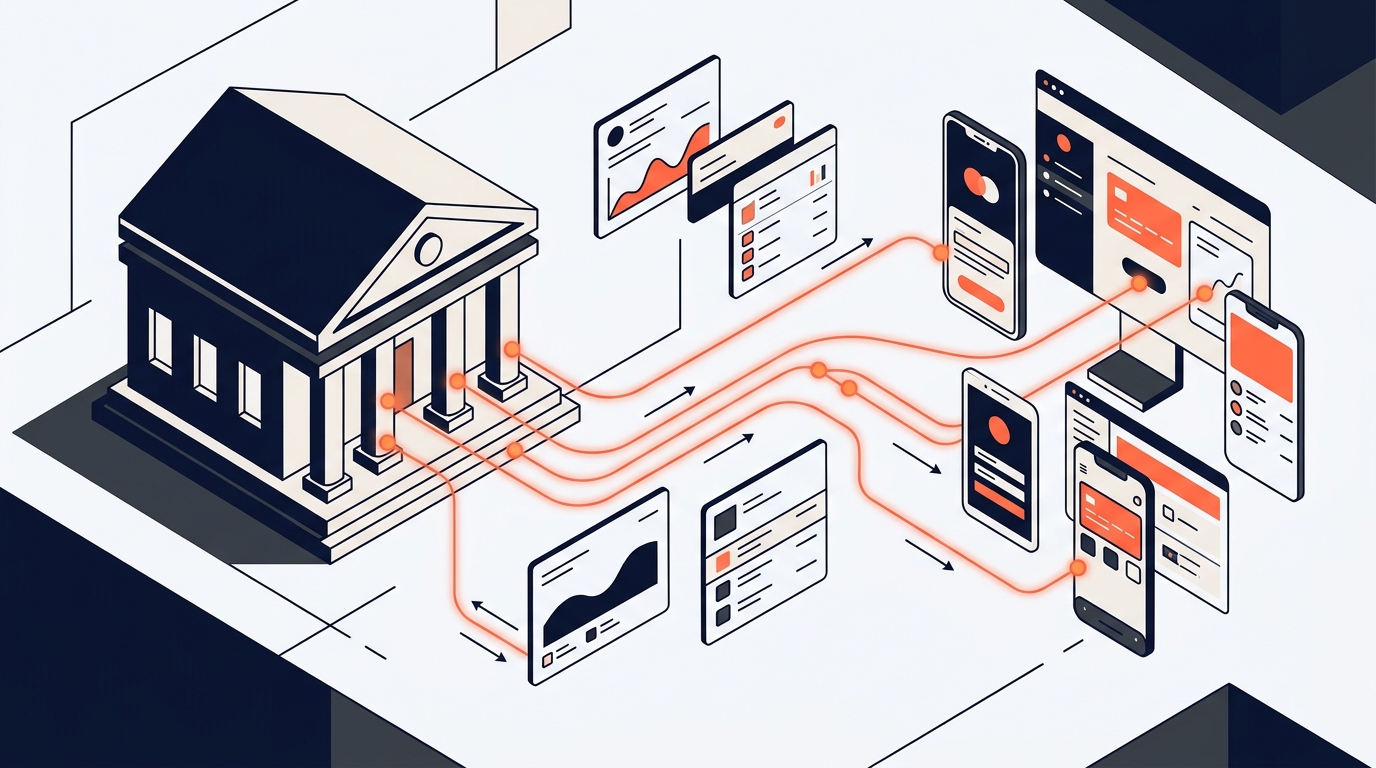
This guide covers the four API layers a modern fintech assembles to launch:
- Data aggregation — read accounts + transactions across banks
- Transfers — move money (ACH, RTP, wire, card)
- Ledgering — keep an internal source of truth
- Insights & derived data — the "safe to spend" or "cash-flow forecast" calculations that make your product feel intelligent
Skip any layer and your product feels either broken (no data) or dangerous (no ledger).
Layer 1 — Data aggregation
What it does: Lets a user link their bank account so your app can read balances and transactions.
Providers: Plaid, MX, Finicity (Mastercard), Yodlee, Tink (Visa), Truelayer, AtlasForge.
What matters when choosing:
- Coverage. The provider must reach the banks your users bank at. Plaid dominates US retail; Tink dominates EU; Truelayer is strong in UK/EU. Ask for a real coverage export before signing.
- Freshness. How often does the API refresh? Plaid's "Real-Time Balance" is on-demand; standard endpoints refresh 1–2× daily. If your product depends on same-day accuracy (Safe to Spend 365, overdraft prevention, buy-now-pay-later underwriting), pay for real-time.
- Auth UX. Test the linking flow on your worst customer's phone. If it takes more than 4 taps, you'll lose 20% of users at signup.
- Webhook reliability. Aggregators send
TRANSACTIONS: DEFAULT_UPDATEwebhooks when new data arrives. If they miss webhooks (some do), your product gets stale.
Layer 2 — Transfers
What it does: Actually moves money.
Rails in 2026:
- ACH — 1–3 business days, cheap ($0.20 per transfer), the workhorse of US fintech.
- RTP / FedNow — 24/7, real-time, higher limits every quarter, fees dropping.
- Wires — expensive ($15–30) but immediate and irrevocable.
- Card push (Visa Direct, MasterCard Send) — near-instant, works to any debit card.
- International — Wise Platform, Nium, and Airwallex offer FX + local rails via API.
Providers: Modern Treasury, Increase, Column, Unit, Treasury Prime, and (for card push) Visa Direct via a sponsor. AtlasForge exposes ACH and card push through partner-bank sponsors.
The compliance trap: Every transfer API layers on top of a chartered bank. Your provider passes the bank's compliance requirements down to you: KYC, OFAC screening, transaction monitoring, dispute handling. Read the "Program Guide" attached to your BaaS agreement carefully. It contains the actual rules.
Layer 3 — Ledgering
What it does: Records the truth about who owes what to whom, at any point in time, in your product.
Why you need it: The bank ledger is not your ledger. If your app credits a user's in-app wallet before the ACH clears, you owe money you don't have. If a user disputes a transaction two months later, you need a point-in-time snapshot to argue.
Options:
- Build it. Postgres + double-entry accounting library. 2–4 weeks of engineering.
- Buy it. Modern Treasury Ledgers, Increase Ledger, or open-source Formance Ledger / tigerbeetle.
The rule: Every user-visible balance must be derivable from ledger entries. If your product manager can update a balance directly in the database without a corresponding ledger transaction, you're going to have a very bad audit.
Layer 4 — Insights and derived data
This is where you differentiate. Aggregated data is a commodity. Turning it into a helpful decision is not.
Examples of derived data products:
- Safe to Spend 365 — "$342 available through Friday" (see our Safe to Spend 365 article)
- Cash-flow forecasting — 30/60/90-day inflow-outflow projection
- Subscription detection — flag recurring charges, surface them for cancellation
- Overdraft prediction — warn users before they overdraft
- Underwriting scores — cash-flow-based credit scoring (Petal, Nova Credit)
AtlasForge's Safe to Spend 365 API computes this in ~40ms end-to-end using an event-driven pipeline: aggregator webhook → derived calculation → cache → your app queries our endpoint.
Security minimums (non-negotiable)
- TLS 1.3 everywhere; no TLS 1.2 fallback for partner traffic.
- API keys never in git. Use environment variables, secret managers (AWS Secrets Manager, HashiCorp Vault, Doppler).
- Webhook signatures. Verify every webhook with HMAC-SHA256. Rotate signing secrets quarterly.
- PII minimization. Never store bank credentials. Aggregators return tokens; store those.
- SOC 2 Type II from your infrastructure provider. Request the report before signing.
A pricing sanity check
For a US retail-fintech that reads 100k transactions/day and moves $500k/month over ACH:
| Component | Monthly cost |
|---|---|
| Data aggregation (Plaid growth plan) | $2,000–4,000 |
| Transfers (Modern Treasury) | $500 base + $0.30/ACH |
| Ledger (self-hosted) | $200 infra |
| Derived insights (AtlasForge) | $0–1,200 depending on volume |
| Compliance vendor (Alloy KYC) | $1,500+ |
Total: $5–10k/month for the first year. Budget more for your first fraud loss.
Code — reading transactions with the AtlasForge API
Once you have an API key, reading a user's transactions looks like this:
curl -H "X-API-Key: afg_live_your_key_here" \
  "https://atlasforgefinancial.com/api/v1/end-users/user_123/transactions?limit=50"
Or in Python:
import requests

r = requests.get(
    "https://atlasforgefinancial.com/api/v1/end-users/user_123/transactions",
    headers={"X-API-Key": "afg_live_your_key_here"},
    params={"limit": 50},
    timeout=10,
)
r.raise_for_status()
for tx in r.json()["items"]:
    print(tx["merchant_name"], tx["amount_cents"] / 100)
Full reference in our Developer Docs — every endpoint has copy-paste examples and a sandbox key you can grab from the Partner Portal.
The founder shortlist
If you're launching a fintech in 2026, here's the fastest stack we recommend to friends:
- Aggregation: Plaid + AtlasForge (Plaid for coverage, AtlasForge for derived insights)
- Transfers: Increase (for ACH/wire, best DX) or Modern Treasury (best for scale)
- Ledger: tigerbeetle if you're technical, Modern Treasury Ledgers if you're not
- KYC: Alloy (best identity vendor coordination)
- Compliance ops: Middesk (business verification) + a fractional CCO
Ship the MVP in 60 days. Fix everything else in production.
Ready to build on AtlasForge?
Get sandbox API keys in 60 seconds — or install the Safe to Spend 365 app.