
Net Worth Tracker vs Budget App: Which Do You Need?
One tool tells you where your money goes. The other tells you what your money is worth. Confusing the two costs you more than a subscription fee.
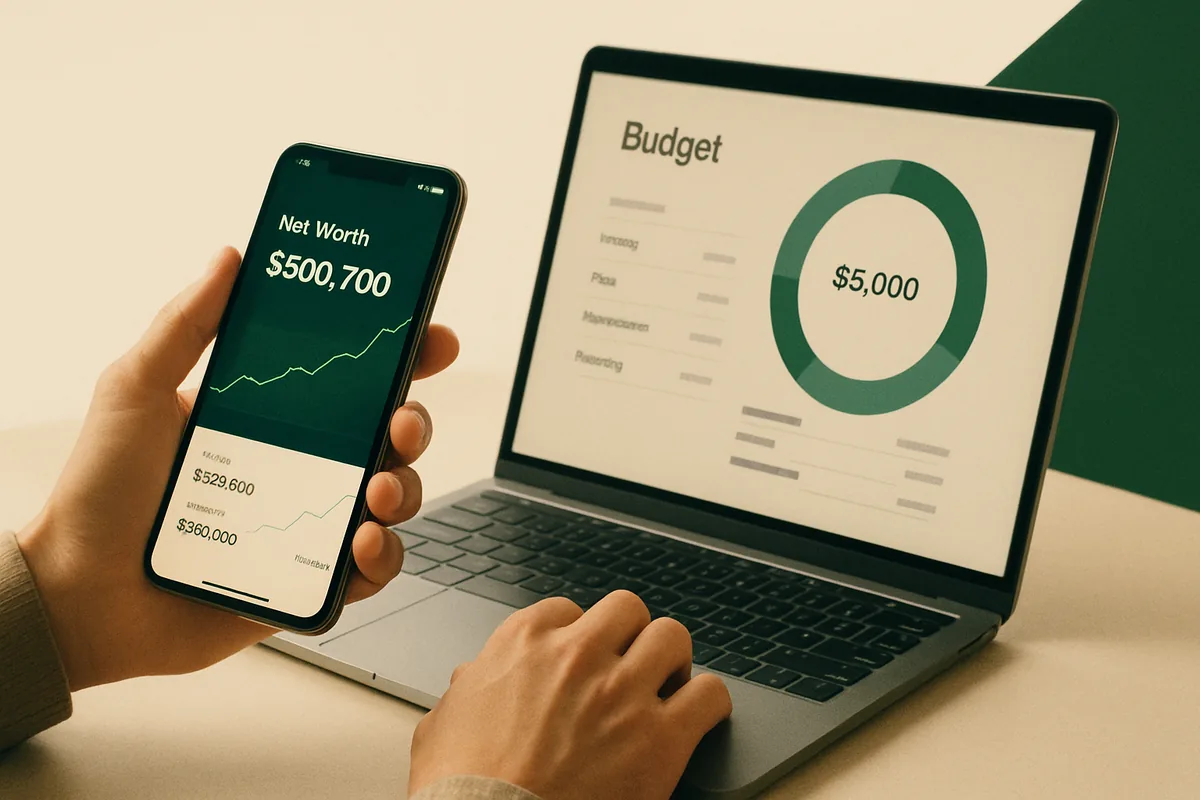
Most people buy the wrong personal finance software for the same reason they buy the wrong running shoe: they walk into the store without knowing what surface they're training on. A budget app and a net worth tracker are not interchangeable. They measure different things, reward different behaviors, and serve different stages of your financial life. Picking the wrong one doesn't just waste $8–$15 a month — it optimizes you for the wrong goal.
This isn't a "best apps of 2026" roundup. It's a decision framework. By the end, you'll know exactly which category of personal finance software matches your current financial situation — and why the answer might change in 18 months.
The Fundamental Difference
Here's the cleanest way to think about it:
- A budget app is a speedometer. It tells you how fast money is moving — in and out, this week, this month, this category.
- A net worth tracker is an altimeter. It tells you how high you are — total assets minus total liabilities, right now, versus six months ago.
Speedometers don't tell you how high you are. Altimeters don't tell you how fast you're going. Conflating the two is how people end up with a meticulously balanced monthly budget and still feel financially lost at 38 because they never built equity.
The Federal Reserve's 2025 Survey of Consumer Finances — the most comprehensive household wealth dataset the U.S. produces — found that median family net worth rose to $192,700 in 2022 (the most recent full dataset), but that figure masks enormous variance by age and income. Families in the 40–49 age bracket had median net worth nearly four times that of families in the 25–34 bracket. That gap isn't primarily explained by income differences. It's explained by asset accumulation behaviors — which budget apps don't track at all.
What Budget Apps Actually Do Well
Let's give budget apps their due. They are genuinely excellent tools for a specific problem: controlling cash flow during a period of financial instability or deliberate behavior change.
The best budget apps do four things well:
- Categorize transactions automatically — linking to your bank and credit accounts via Plaid or similar aggregators, then sorting spending into buckets (groceries, dining, utilities, subscriptions).
- Set and enforce spending limits — alerting you when you're 80% through your restaurant budget with a week left in the month.
- Surface wasteful patterns — showing you that you spent $340 on food delivery in March even though you swore you were cooking at home.
- Facilitate zero-based or envelope budgeting — methodologies that require every dollar to be assigned a purpose before the month begins.
These are meaningful capabilities. The CFPB's 2024 Financial Well-Being report found that Americans who actively tracked spending were 23% more likely to report feeling financially secure than those who didn't — though correlation and causation are legitimately blurry here.
Where budget apps fall short: they have almost no memory. They're oriented toward the current period. Most of them show you 90 days of history and call that "trends." They don't tell you whether your net worth is growing, whether your debt-to-asset ratio is improving, or whether your investment allocation has drifted 15 percentage points from your target. They see the trees, not the forest.
Who Should Prioritize a Budget App
- You carry a credit card balance month-to-month and need to find the leak
- You've recently had a major income change (new job, divorce, a child)
- You're saving toward a specific short-term goal with a deadline (a house down payment in 18 months)
- You've never actually tracked where your money goes and the answer genuinely surprises you every month
What Net Worth Trackers Actually Do Well
A net worth tracker is a balance sheet tool. It aggregates every asset you own — checking accounts, brokerage accounts, retirement accounts, real estate equity, crypto, even the Kelly Blue Book value of your car — and every liability you owe — mortgage balance, student loans, auto loans, credit card debt — and subtracts the second from the first.
The number it produces is your net worth. Updated daily (or weekly, depending on the tool), it becomes a financial vital sign. You stop asking "did I overspend on dining this month?" and start asking "is my net worth growing at a rate consistent with my retirement timeline?"
Net worth trackers excel at:
- Long-horizon trend analysis — showing you that your net worth has grown $47,000 over 24 months, even during months when your budget felt chaotic.
- Asset allocation visibility — revealing that 78% of your net worth is in a single employer's 401(k), which is a concentration risk worth addressing.
- Debt payoff motivation — watching your mortgage balance decrease in real time, expressed as its impact on your overall net worth, is more motivating than a payment confirmation email.
- Cross-account rebalancing prompts — flagging when your taxable brokerage has drifted from its target allocation.
- Financial independence math — if you're tracking toward FIRE or a specific retirement date, net worth is the only number that actually matters for that calculation.
The 4% rule, popularized by the 1998 Trinity Study and updated in subsequent research by Pfau and Kitces, is calculated against your portfolio's total value — not your monthly budget surplus. You cannot reach financial independence without tracking net worth. Full stop.
Net worth trackers are weaker on behavioral guardrails. They don't stop you from ordering DoorDash four times a week. They don't tell you that you're overspending on Amazon. They assume you've solved the cash flow problem and are now focused on wealth accumulation.
Who Should Prioritize a Net Worth Tracker
- You have a positive monthly cash flow and want to ensure it's compounding efficiently
- You're within 15 years of your target retirement date
- You have assets across multiple institutions (401k, IRA, taxable brokerage, real estate) and lack a unified view
- You're building generational wealth or managing a complex financial picture across a household
- Your income is variable (freelancers, business owners, commission-based earners) and monthly budgeting is too granular to be useful
The Stage-of-Life Framework
Here's the decision matrix most financial software companies don't want to give you, because it implies you might only need one product at a time:
Phase 1: Cash flow negative or unstable (income < expenses, or income highly variable) Priority tool: Budget app. You cannot invest what you don't have. Fix the plumbing before upgrading the house.
Phase 2: Cash flow positive but assets minimal (saving rate > 0, net worth under ~$50,000) Priority tool: Budget app with a secondary net worth check-in monthly. The budget keeps you on track; the net worth tracker proves the budget is working.
Phase 3: Cash flow stable, meaningful assets accumulating (net worth $50,000–$500,000) Priority tool: Net worth tracker, with a budget app used quarterly for audits. At this stage, optimizing asset growth and allocation matters more than granular category tracking.
Phase 4: Wealth management mode (net worth $500,000+, or approaching retirement) Priority tool: Net worth tracker, likely supplemented by a fee-only financial advisor who provides tax-optimized rebalancing guidance. A budget app is nearly irrelevant at this stage — cash flow discipline is assumed.
This isn't a rigid ladder. A 29-year-old earning $180,000 in San Francisco who has been lifestyle-inflating for three years might be squarely in Phase 1. A 45-year-old teacher with a pension, a paid-off home, and maxed retirement accounts might be in Phase 4. Income is not the determining variable. The ratio of deliberate savings to total income is.
Where the Categories Blur — and Where They Don't
Some products market themselves as doing both — comprehensive personal finance software that tracks your spending AND your net worth. A few do this credibly. Most do one thing well and treat the other as a dashboard afterthought.
The honest test: open the app and ask yourself which question it answers most clearly. "Where did my money go this month?" is a budget app question. "Am I wealthier than I was 12 months ago?" is a net worth tracker question. If the interface makes one of those questions hard to answer, that's your category assignment.
According to a 2026 Statista survey on personal finance app usage, 61% of Americans who use a financial app use only one — and 74% of those users chose it based on the first problem they needed to solve, without revisiting the decision as their financial situation evolved. That's a significant alignment gap between tool and need.
The Wall Street Journal's 2025 analysis of fintech retention data found that users who switched from budget apps to wealth-tracking tools after reaching a net worth milestone reported substantially higher financial satisfaction scores — not because the new tool was better designed, but because it was better matched to their actual problem.
The Dual-Tool Case (And When It's Worth It)
There's a legitimate argument for running both simultaneously — but only if you use them deliberately and don't let them overlap into redundancy.
The winning combination:
- Budget app handles inflows and outflows, enforces spending limits, and keeps your savings rate on target.
- Net worth tracker measures the result of that discipline over time, confirms that savings are actually compounding, and keeps long-horizon goals visible.
The failing combination: two apps that both show transaction history and both show a net worth estimate, but neither does either thing particularly well. That's $25/month in subscription fees and twice the cognitive overhead for half the clarity.
If you're going to run both, keep them in separate mental compartments. Budget app is a weekly or biweekly ritual. Net worth tracker is a monthly or quarterly ritual. Different cadences, different questions, different decisions triggered.
Choosing Thoughtfully in 2026
The personal finance software market is more crowded than it's ever been. Following Mint's 2023 shutdown, a wave of alternatives rushed to fill the gap — some budget-first, some net-worth-first, some genuinely hybrid. That's good for competition. It also means the marketing language has homogenized to the point where it's nearly impossible to tell what category a product belongs to from its landing page alone.
Do the work the landing page won't do for you: download the trial, look at the default home screen, and ask which of the two core questions it answers first. That's your answer.
If you're in the net-worth-tracking camp and managing money across multiple accounts with an eye toward long-term wealth accumulation, Safe to Spend 365 by AtlasForge Financial is built specifically for that stage of the financial journey — giving you a consolidated balance sheet view, real-time asset tracking, and forward-looking net worth projections tied to your savings rate and investment returns. For households with more complex financial pictures — variable income, multiple asset classes, business equity — Ember360 provides the layered wealth visibility that spreadsheets approximate but rarely deliver cleanly. And if you're building financial tools for your own users, the AtlasForge Financial API exposes the same balance sheet aggregation engine via a documented REST interface. The right tool exists. The more important work is knowing which problem you're actually trying to solve.
Ready to build on AtlasForge?
Get sandbox API keys in 60 seconds — or install the Safe to Spend 365 app.